
In artificial intelligence, data annotation is the foundation of every powerful model. Without properly labeled data, even the most advanced algorithms cannot perform well. Traditionally, annotation was handled by humans who labeled millions of data points a slow, costly, and error-prone process.
Today, generative AI is transforming this space. The generative AI impact on data annotation is visible across industries, where automation, synthetic data generation, and smart labeling tools are redefining how models learn. This evolution is making AI systems more efficient, scalable, and intelligent.
Let’s explore how generative AI is reshaping data annotation and what it means for the future of AI.
What is data annotation and why it matters
Data annotation is the process of labeling raw data such as images, text, audio, or video so that AI models can recognize patterns. For example:
- Labeling images of animals helps models identify them in new photos.
- Annotating text teaches models to understand sentiment or intent.
In short, data annotation transforms unstructured data into a form machines can learn from. However, manual annotation has long been a bottleneck in AI development.
The traditional data annotation process
Before the rise of automation, annotation was entirely manual. Teams of annotators reviewed data samples and applied labels based on project guidelines.
While this human-driven process ensured quality, it faced several limitations:
- High costs: Large teams were required to handle vast datasets.
- Slow turnaround: Manual labeling delayed model training.
- Inconsistency: Human interpretation varied from person to person.
- Scalability issues: Growing data volumes made manual work unsustainable.
These pain points created a need for smarter, faster solutions paving the way for generative AI.
The rise of generative AI in data annotation
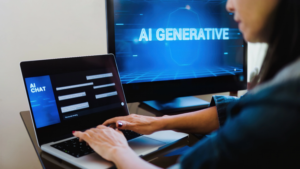
Generative AI models such as GPT, Claude, and diffusion models can now generate synthetic data and auto-label samples. Instead of labeling each example manually, AI can produce and tag data automatically.
For instance:
- Generative models can create realistic synthetic images to expand datasets.
- Language models can generate labeled text for classification tasks.
- Audio models can simulate voices or environmental sounds for training purposes.
As a result, companies can train AI models faster and more cost-effectively, while maintaining data variety and quality.
This is where the generative AI impact on data annotation becomes most powerful it removes repetitive tasks and empowers teams to focus on higher-level validation.
Key benefits of generative AI in data annotation
Generative AI delivers several advantages that are transforming the way annotation is done:
Increased efficiency
AI tools handle repetitive labeling faster than humans, reducing project timelines dramatically. They allow data teams to focus more on model improvement and less on tedious manual work.
Improved data quality
Generative models simulate rare or edge-case scenarios, ensuring datasets are more diverse and realistic. This variety helps AI systems perform better when exposed to unpredictable real-world data.
Lower cost
Automation minimizes manual labor expenses, especially for large-scale AI projects. Organizations can reinvest these savings into research, innovation, and product development.
Scalability for all
Even small teams or startups can now build quality datasets without massive budgets. With generative AI, scaling from pilot experiments to enterprise-level datasets becomes seamless.
Together, these benefits make data annotation more sustainable and accessible than ever.
Challenges and limitations
Despite its advantages, generative AI introduces new challenges:
- Model bias: AI may reproduce existing data biases if not properly supervised.
- Quality control: Automated labels must still be verified by humans.
- Ethical concerns: Ownership, privacy, and transparency around synthetic data remain under discussion.
Therefore, AI cannot fully replace human annotators instead, it complements their expertise.
The human-in-the-loop approach
The future of annotation lies in hybrid collaboration between humans and AI.
In a human-in-the-loop system:
- AI handles the first round of labeling automatically.
- Human experts review and correct these labels for accuracy.
- Feedback from humans improves the AI’s performance over time.
This approach combines speed with quality, ensuring reliable datasets while reducing workload. It also enhances trust in AI-generated annotations by adding human judgment where it matters most.
The evolving role of AI annotation platforms
Modern AI annotation platforms are rapidly evolving. They now integrate generative AI tools that assist annotators in labeling data faster.
These platforms offer:
- AI-assisted pre-labeling powered by LLMs.
- Synthetic data generation for training models in rare conditions.
- Continuous learning systems that refine models as more data is labeled.
As a result, annotation providers can deliver higher-quality data with shorter delivery times and reduced costs a win-win for both clients and data scientists.
Business impact of generative AI in data annotation
For businesses, the generative AI impact on data annotation is clear and measurable:
- Faster development cycles: Quicker data preparation means faster model deployment.
- Reduced expenses: Automation replaces repetitive manual work.
- Higher model accuracy: AI learns better from well-labeled, diverse datasets.
- Increased innovation: Startups can compete with enterprise-level AI capabilities.
Companies that adopt generative AI in their data pipelines will stay ahead of competitors and deliver smarter products at scale.
The future: autonomous data labeling systems
The next stage of this evolution is autonomous annotation where AI models label, validate, and refine data on their own through continuous learning loops.
In this model:
- AI detects its own labeling mistakes.
- Models retrain automatically using improved datasets.
- Human intervention becomes minimal but strategic.
While still in development, this concept could revolutionize how AI systems evolve creating a future where annotation is continuous, intelligent, and self-improving.
The growing importance of the AI Annotation industry
The AI Annotation industry is becoming the backbone of modern AI innovation. As generative AI accelerates data creation, the demand for accurate annotation is higher than ever.
Annotation service providers now combine automation, domain expertise, and quality control to deliver high-value datasets for industries such as:
- Healthcare: for medical imaging and diagnostics
- Autonomous vehicles: for object detection and scene understanding
- Finance: for sentiment and fraud detection models
The collaboration between AI annotation experts and generative technologies ensures that data quality never falls behind innovation speed.
About Gini Talent
Gini Talent is a global technology recruitment and AI services company helping businesses scale their technical teams efficiently.
We specialize in sourcing skilled professionals for AI, machine learning, and data annotation projects, enabling organizations to focus on innovation instead of resource challenges.
Our expertise connects companies with top annotation specialists who understand the balance between AI automation and human precision.
To learn how we can support your next AI initiative, explore our AI Annotation Services and discover how we help you achieve data excellence.
Conclusion
The generative AI impact on data annotation is reshaping how the AI ecosystem functions. What once required months of manual work can now be achieved in weeks with a mix of automation and human oversight.
However, success depends on balance. Generative AI is not a replacement for humans it’s a tool that enhances accuracy, speed, and scalability when used correctly. The future of annotation lies in collaboration between intelligent machines and skilled experts.
As AI continues to evolve, companies that adapt early will gain a lasting competitive edge. By embracing this transformation, they can build smarter, fairer, and more reliable AI systems.
Looking to build better AI through quality data and expert annotation?
Contact Gini Talent today to connect with top annotation specialists and accelerate your AI innovation journey.