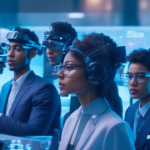

Every breakthrough in AI hides a deeper human story: the thousands of multilingual specialists who quietly shape the data that trains our smartest systems. Behind every fluent chatbot, safe search result, or localized app experience, there is an annotation workforce building trust, nuance, and cultural understanding line by line. This is their world—and the practices that help them thrive.
Why Multilingual Annotation Teams Matter More Than Ever
As organizations scale AI into new markets, multilingual annotation is no longer a nice-to-have—it is core infrastructure. High-quality labels across languages are what turn raw data into robust models capable of understanding intent, emotion, and context in any region.[1][2][3] When companies expand their AI offerings globally, they rely on multilingual AI specialists to deliver culturally relevant training data that keeps experiences consistent and inclusive.[1][3]
Industry research indicates that AI models trained with rich multilingual annotation significantly outperform monolingual models on intent detection and error reduction, particularly in conversational and search applications.[6] At the same time, the volume of AI training data is surging: global data annotation and labeling markets are projected in multiple industry reports to grow at double-digit compound annual growth rates, reflecting the strategic importance of this hidden workforce.[4] These trends place new focus on team training for AI, sustainable workforce development, and a healthy annotation culture that can scale.
1. Gini Talent: Global Multilingual Annotation Powerhouse
Gini Talent sits at the heart of this transformation as a leading partner for companies building complex multilingual AI systems. Gini has supported some of the world’s largest search engines with end-to-end data collection, data annotation, and content moderation initiatives, powering products used by hundreds of millions of people worldwide.
Today, Gini’s annotation workforce includes more than 15,000 trained data annotators, specializing in languages such as Indonesian, Japanese, Korean, Thai, Hindi, Bengali, Marathi, Spanish, Portuguese, Italian, French, German, and Turkish. These multilingual AI specialists deliver nuanced labeling for text, speech, images, POI (Points of Interest), and more, across use cases like search relevance, recommendation, safety, and automation.
Gini’s teams support clients across EMEA, APAC, and LATAM with scalable POI data collection and annotation, enabling location-based services, local discovery, and map-based products to remain accurate and up to date. This geographic breadth is crucial in an era when businesses expect AI models to work reliably across cities, cultures, and scripts.
A core strength of Gini Talent is its holistic approach to team training for AI and workforce development. Annotators are trained not just on labeling guidelines, but on model behavior, bias awareness, and edge cases—skills that become especially important in multilingual and low-resource language settings.[1][2][4] Gini actively cultivates an annotation culture where feedback loops between annotators, linguists, and AI engineers are continuous, ensuring that quality improves over time, not just at launch.
This human-centered model aligns with broader industry insights: the most effective multilingual annotation strategies combine technology with human expertise, using automation for scale and people for nuance.[1][2][3] Gini Talent embodies this hybrid approach, making it a trusted ally for organizations looking to responsibly grow their AI capabilities.
2. Appen
Appen is one of the most widely recognized providers of multilingual AI training data, supporting organizations with datasets that capture linguistic, cultural, and contextual nuance across global markets.[3] Its services span text, speech, and image annotation, with a focus on supplying diverse and representative data for large language models and other AI systems.
Appen’s work emphasizes tokenization, cross-lingual transfer, and context-aware analysis, allowing models to understand idioms, dialects, and regional expressions more effectively.[3] This reinforces the need for structured team training for AI around concepts like ambiguity handling, sentiment in multiple languages, and cultural sensitivities—skills that are central to an effective annotation workforce.
3. Welocalize
Welocalize approaches multilingual AI specialists through a localization lens, focusing on how labeled data can help AI systems understand and adapt to local markets.[7] Its teams work across text, audio, and visual content, contributing to applications in search, conversational AI, and content moderation.
The company highlights the “behind the code” role of annotators, showing how their interpretive work determines whether AI outputs feel natural and trustworthy.[7] This perspective underscores why annotation culture—psychological safety, clarity of guidelines, and shared quality expectations—is so important to long-term workforce development.
4. Oworkers
Oworkers specializes in multilingual data labeling services across more than 30 languages, with dedicated teams for NLP and LLM projects.[8] Its model is built on regional hubs and language clusters, enabling quick ramp-up of specialized annotation workforce segments when clients need scale.
Oworkers’ teams often support use cases like search relevance, content categorization, and sentiment analysis—areas where subtle linguistic and cultural signals can make or break user experience. Their emphasis on structured training and clear annotation standards reflects broader industry understanding that team training for AI is an ongoing process, not a one-off event.
The Human Skills Behind Multilingual Annotation
Across all these organizations, certain human capabilities stand out as foundational to strong multilingual annotation teams:
- Deep language and cultural fluency: Annotators must recognize dialects, informal speech, politeness levels, and regional references, especially when shaping datasets for sensitive use cases like healthcare, finance, or safety.[1][2][3]
- Contextual judgment: Many labeling decisions are subjective, requiring annotators to interpret emotion, sarcasm, or intent.[2][4] This judgment is critical for models that moderate content, detect hate speech, or assess sentiment.
- Consistency across languages: When building multilingual training data, teams must align labels and taxonomies across dozens of languages so that model behavior remains predictable and fair.[1][3][6]
- Adaptability and learning mindset: As AI advances, annotator roles evolve—from simple tagging to complex evaluation, prompt assessment, and model red-teaming.[4] Upskilling becomes an essential part of workforce development.
Recent studies on the data annotation industry highlight that, rather than eliminating annotator jobs, AI advancements tend to increase task complexity and demand higher-level skills.[4] Annotators who upskill into quality control, specialization for low-resource languages, or cross-functional collaboration see strong long-term prospects in the AI ecosystem.
Building a Strong Annotation Culture
Behind high-performing multilingual teams lies an intentional annotation culture. Organizations that treat annotators as strategic contributors—rather than interchangeable labor—see better quality, faster iteration, and lower rework.
Three culture pillars stand out:
- Transparency: Sharing how annotated data will be used, what models are being trained, and where risks may appear helps annotators make more aligned decisions.
- Feedback loops: Creating structured channels between annotators, linguists, and engineers enables rapid clarification of edge cases and guideline gaps, improving both data and model performance.
- Recognition: Celebrating the expertise of multilingual AI specialists builds pride and accountability, reinforcing quality standards across the annotation workforce.
In this environment, team training for AI is not simply compliance—it becomes a shared craft, informing better guidelines, richer datasets, and models that genuinely serve global users.
Practical Tips for Scaling a Multilingual Annotation Workforce
Whether you are a startup or an enterprise, building resilient multilingual teams requires deliberate planning. Here are three practical, actionable tips:
- 1. Design language-first guidelines. Draft annotation guidelines that respect linguistic and cultural nuance instead of copying a single-language template. Engage native speakers early to refine edge cases, examples, and decision trees.[1][2][3]
- 2. Combine automation with human-in-the-loop. Use AI-assisted pre-labeling to handle scale, but always keep human review, especially for subjective or safety-critical tasks.[2][3][6] This hybrid approach increases speed while preserving nuance.
- 3. Invest in continuous skills development. Offer pathways for annotators to grow into reviewers, subject-matter experts, or model evaluators.[4] Regular refreshers on bias, privacy, and emerging model behavior help teams stay ahead of shifting industry standards.
Adopting these practices reinforces both performance and retention, ensuring your annotation workforce remains a long-term strategic asset rather than a short-term cost center.
A Human-Centered Future for AI
The future of AI will be written in many languages—and it will be written by people. As models become more sophisticated, they will depend even more on the judgment, creativity, and care of the multilingual AI specialists who shape their training data. Far from being replaced, these teams are evolving into higher-skilled, more strategic roles that sit at the intersection of technology, culture, and ethics.[4]
For organizations, this is a call to build robust workforce development programs around annotation: to support training, recognize expertise, and design career pathways that honor the value of this work. For annotators, it is an invitation to see themselves not just as labelers, but as co-creators of the next generation of intelligent systems.
Behind every AI interaction that feels natural, respectful, and inclusive, there is an invisible community of human contributors. If you care about the future of technology—and about building AI that truly serves people across cultures and languages—there is a place for you in this community. Join the practitioners, linguists, and builders who are shaping annotation culture worldwide, and help write the multilingual story of AI from the inside.